Remember When We Explained a War on a Swing Set in Barga
A Saturday market in a Tuscan hill town, a playground down in the valley, and a stone bridge the Germans mined in 1944 that never went off — fifty yards from the swings.
"Did anyone die on it?"
Lucy asked it mid-push, feet out in front of her, on a swing set at the bottom of a valley in Barga. The bridge she was asking about was maybe fifty yards straight ahead.
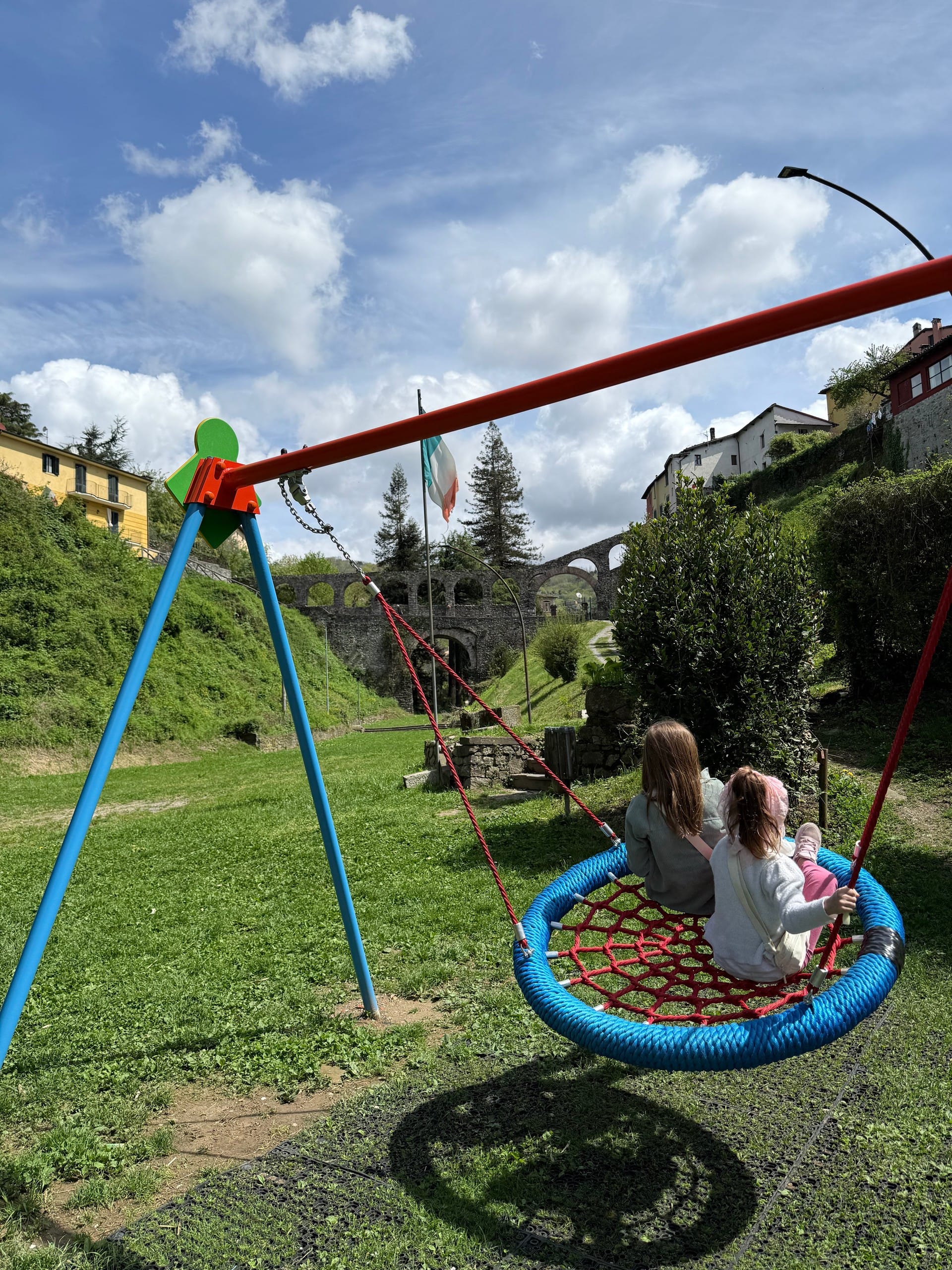
Then the rest came, the way they always do with her. Why was there a battle here? Who were the Germans? How did the bridge not blow up? Is anyone still alive who was there? Were kids killed?
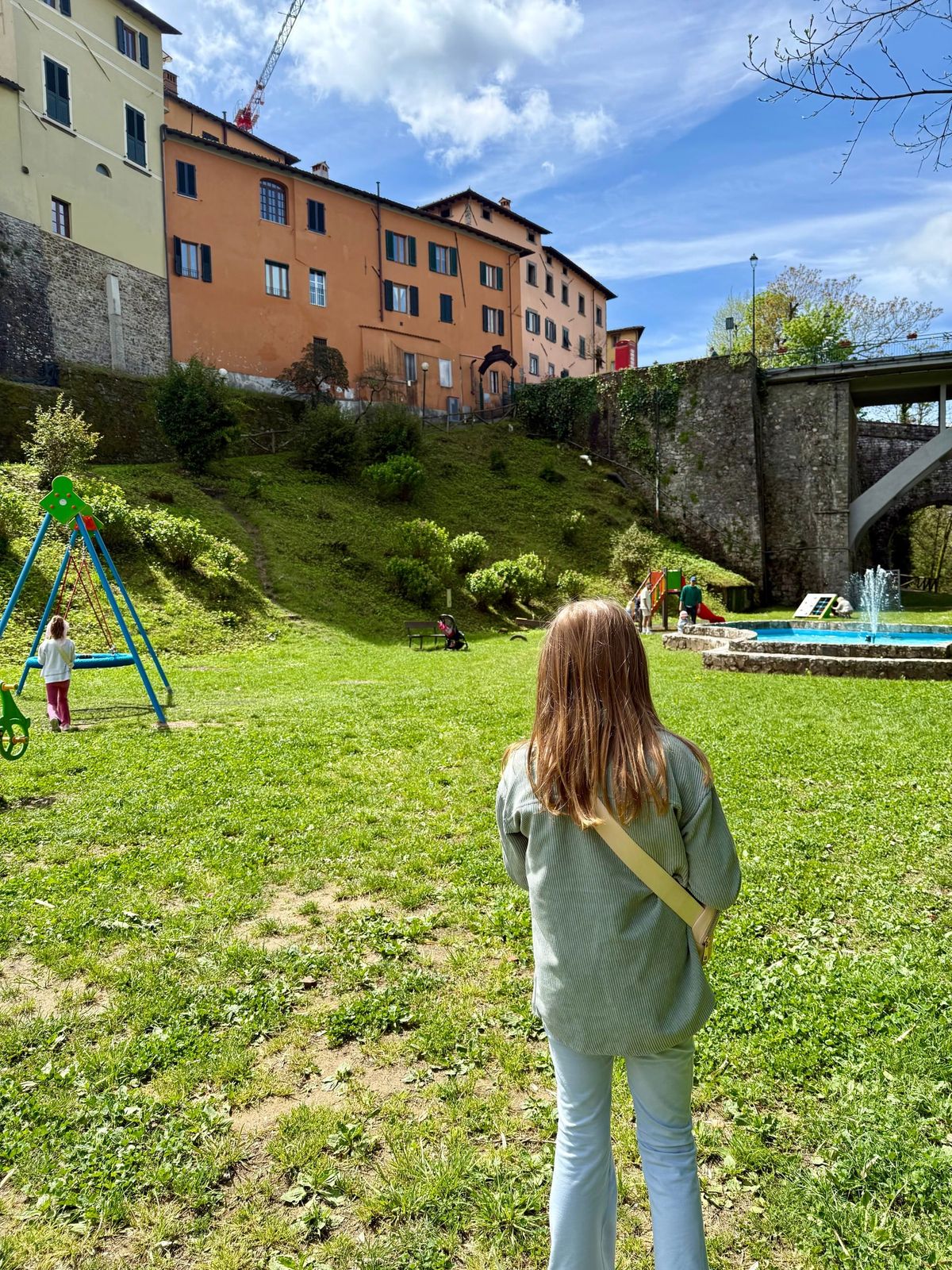
Twenty minutes earlier we'd been up on the hill above it, looking down. That's how we spotted the playground — a genuinely good one, which is not a given in Italy — sitting at the bottom of a valley with two- and three-story buildings stacked up on either side of it. A long path dropped down to it. Bright green grass, a turquoise stone fountain bubbling away in the middle, a small soccer pitch tucked under one of the bridges, and a single construction crane peering over the rooftops behind. The girls took the path at a jog, gelato cones held out in front of them, pausing to get a lick in before it toppled.
While they played, Heather and I walked to the far side to look at the stone bridge — narrower than the others, old in a way you could feel. She read the Italian plaque and translated it on the spot: "This bridge is famous because the retreating Germans in World War II weren't able to blow it up. There were battles here."
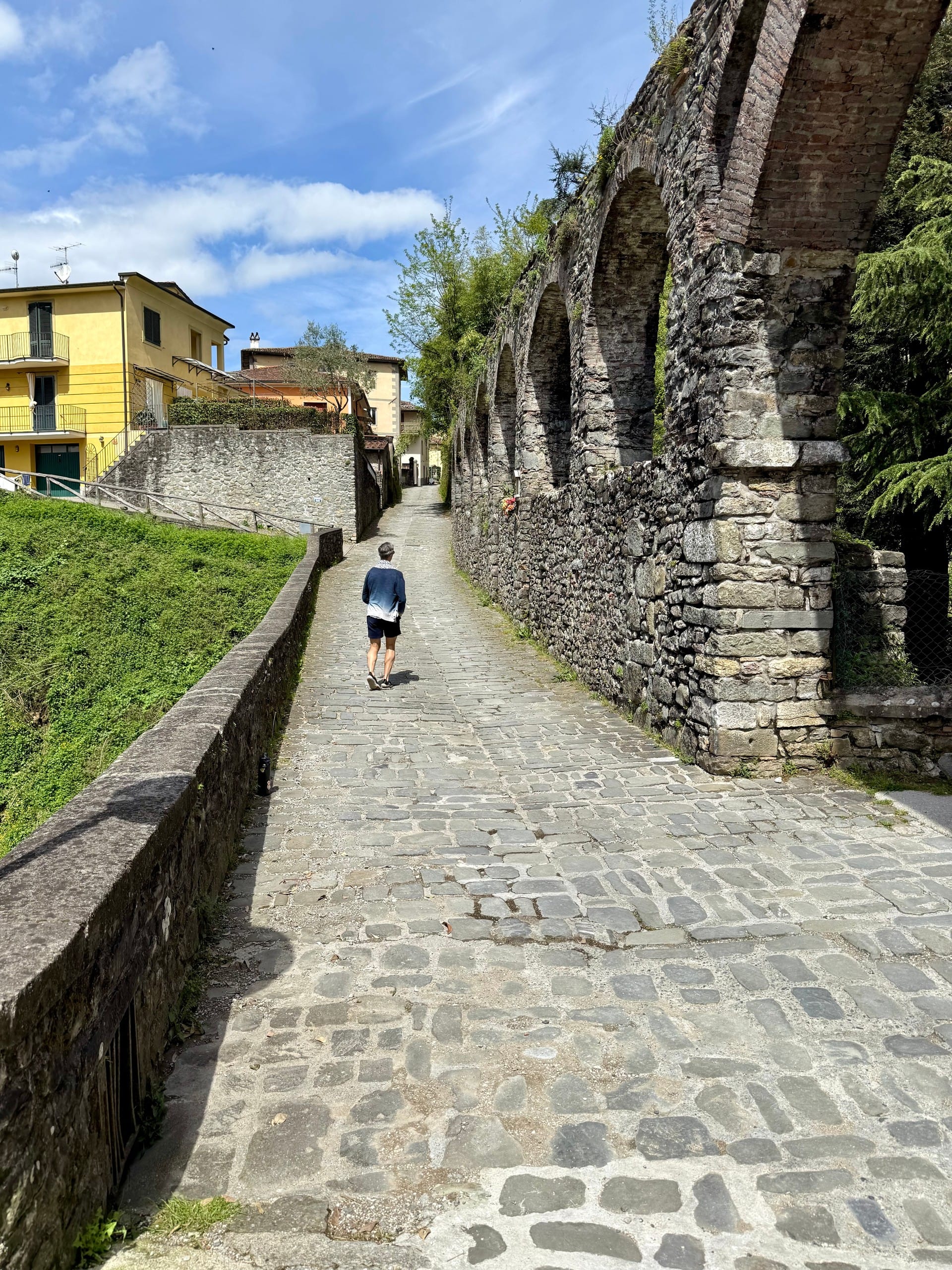
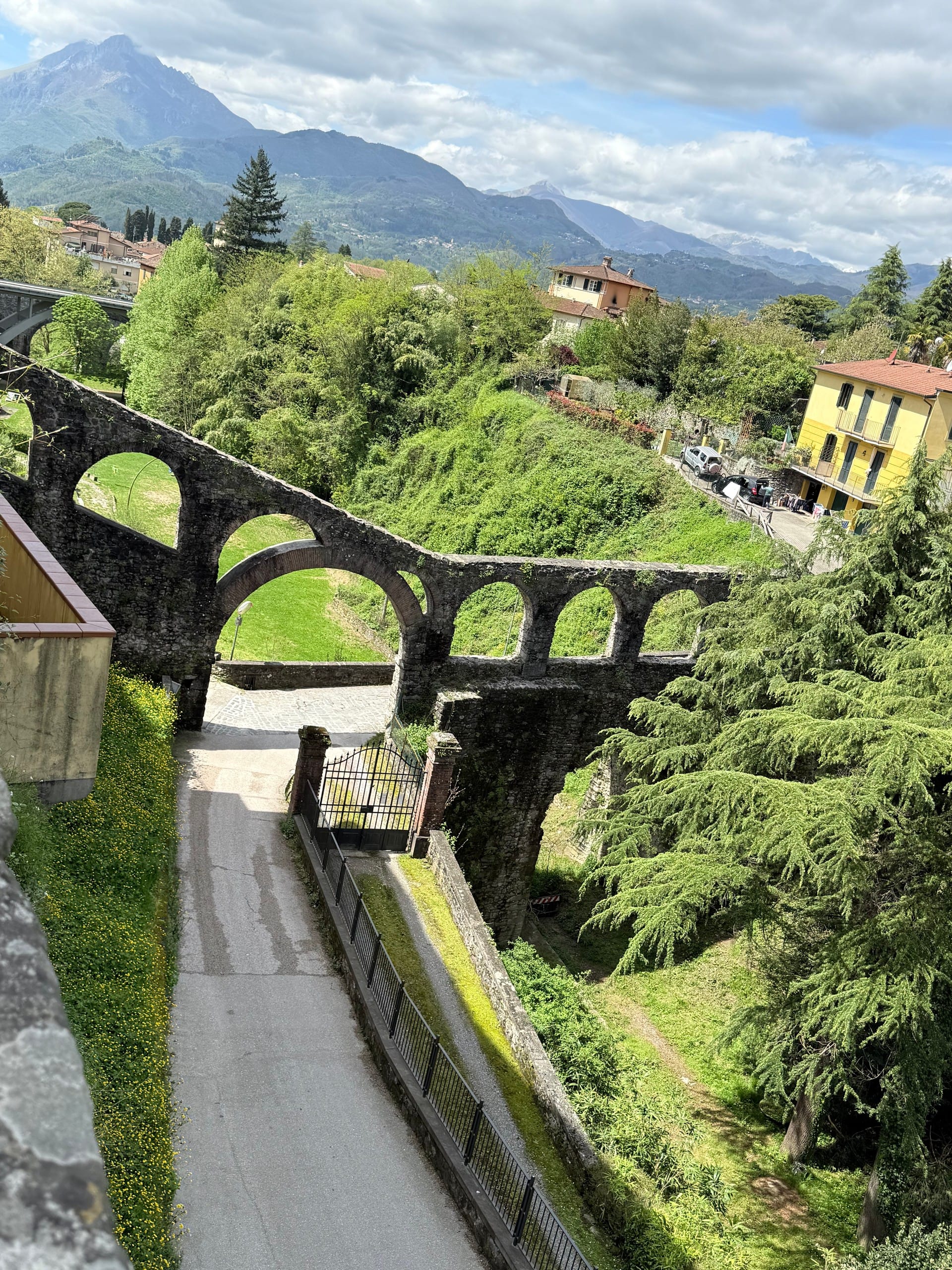
The Porta Macchiaia bridge — mined in 1944, and it never went off.
Later we learned what that meant. The Germans mined the Porta Macchiaia bridge in 1944 along with two others down in the Giardino. The other two blew. For this bridge, the charge never went off. The fighting even had a name — the Battle of Garfagnana. The town changed hands twice inside of two weeks that December.
Standing there, my mind went straight to it. Shutters pulled closed. Shouts echoing off these homes. Tanks on the same streets we'd just walked down with gelato.
The part that doesn't fit on a lesson plan
So there we were on a Saturday afternoon, pushing swings, explaining what a war actually does to a town — to a kid whose only reference point for it was a bridge she could see from where she was sitting.
A book gives you a date and a paragraph, and a question at the end that someone else wrote.
Barga gave us a street we'd walked that morning and a bridge someone tried to blow up and couldn't.
The questions got better, and they got harder. Ours went from what happened to who were they to were there kids in about ninety seconds. Nobody assigned a single one of them.
Getting to Barga, Tuscany — and why we went at all
We were in Florence for the month. Barga was a two-night detour out of it, April 18–20, 2025.
We went because of Easter weekend. The Florence Airbnb we wanted wasn't available at the price we wanted — Easter in Florence is expensive for reasons that deserve their own post — so we needed somewhere else to be for two nights. Barga solved that, and gave us the thing we'd actually been hoping for: somewhere most people never put on a Tuscany list.
How we got there. We'd already dropped our bags in Florence and picked up a rental car there — a white BMW 2 Series convertible, booked through Auting, a car-sharing service. €122.55 for the full 48 hours. From Florence we ran out through Pisa, past the tall walls of Lucca, then weaved up through the hills into the Serchio valley. About two hours and fifteen minutes, door to door.
Go on a Saturday. That's market day on the plaza, and the market is the reason the town is worth a morning rather than an hour. Mustard and terracotta buildings ring three sides of it, with the pass-through street on the fourth and a small patch of grass along one edge. White vans park with their back doors open while vendors restock. Folding tables run heavy with clothes, shoes, and rugs.
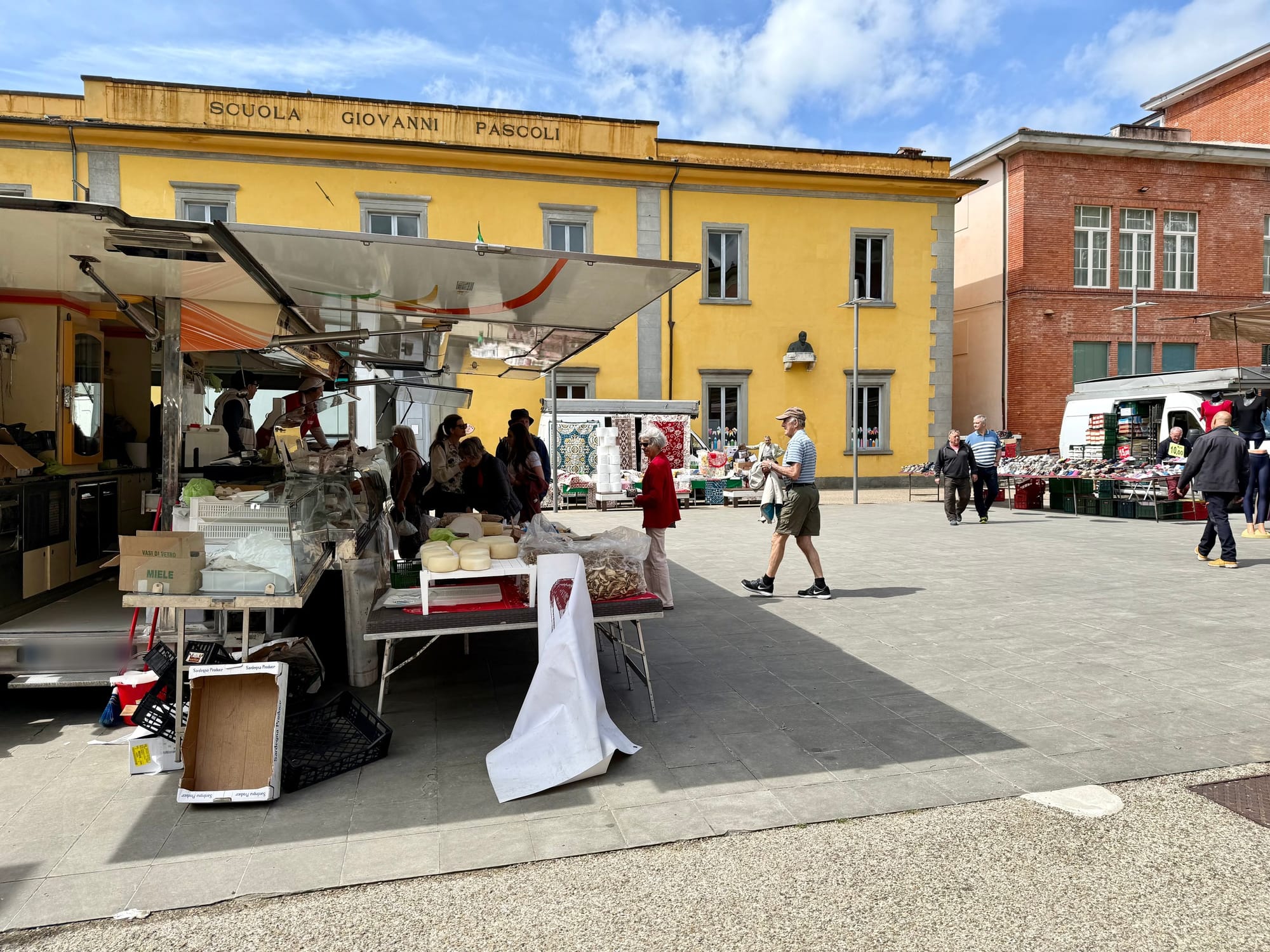
Cool mountain air in the morning — long sleeves, and you want them. By midday everyone's down to short sleeves. Blue sky with wispy clouds. And a steady hum, the kind you hear in a crowded church lobby after a Sunday service. The whole town out for shopping and for each other.
Where we stayed. Renaissance Tuscany Il Ciocco Resort & Spa, two nights. We booked it on Marriott points — the cash rate was running about $251 a night that weekend. A resort is the exception for us, not the pattern: two nights out of roughly three hundred. Most of our nights are month-long home rentals in residential neighborhoods, with hotels in between when a travel day or a short stop calls for one. This was a holiday weekend in a region where the normal option had priced itself out, and we made a call.
What I got wrong. There was a truck at the market with its whole side folded up into an awning — a glass counter underneath, cheese wheels stacked on top, olives, cured meat, pastry. I ordered off Google Translate: "Vorrei 1 kg di pecorino." What came back was a full wheel of a local farmer's pecorino, rind and all, the size of a classroom wall clock.
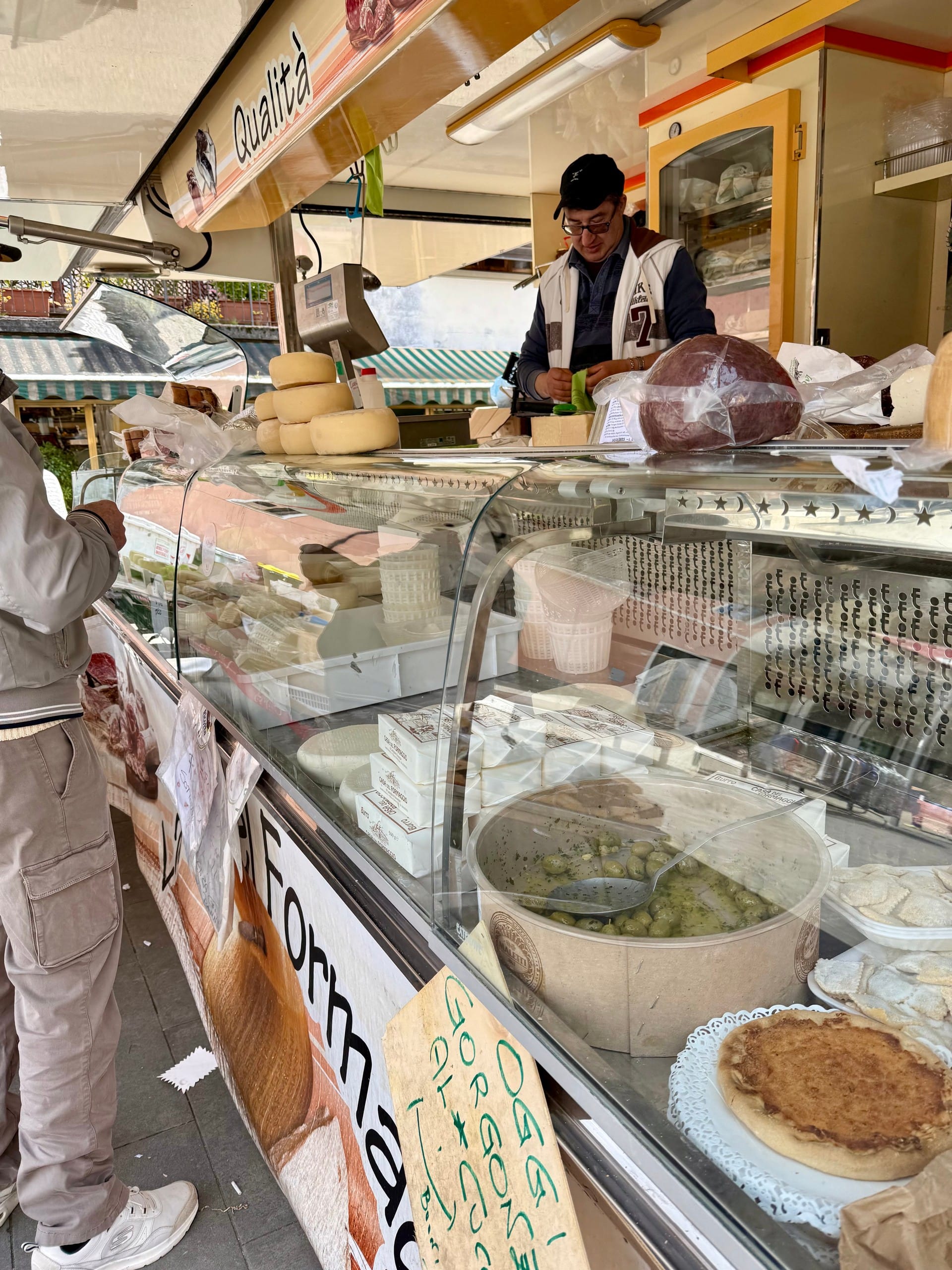
The vendor looked at me sideways, said something in Italian, and then — I'm fairly sure — read the excitement on my face and decided not to correct me. My eyes went wide at the wheel. They went wider at the price. Then it landed: I'd thought I was asking for about a pound. One kilogram is 2.2 pounds. I played it cool, right up until Heather saw it and asked where exactly I planned to store it. We still bring it up.
What Barga taught them (worldschooling, not a classroom)
Nobody handed our girls a WWII unit that weekend. They found a playground, ate gelato, and then asked, unprompted, about a battle — because the evidence of it was in their line of sight and we didn't change the subject.
This isn't reading about a war. It's that the bridge you're looking at from your swing had real young men on it, shouting at each other, scared about what came next. It's not a story on a page. It's a scene you're standing in.
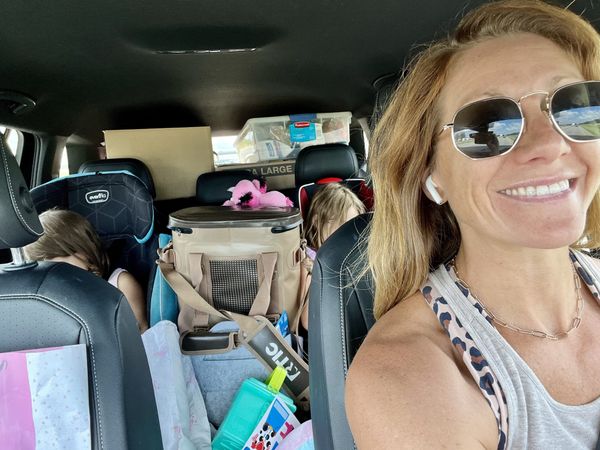
The questions kept coming from the back seat on the way out, top down through Barga's winding streets — was there fighting there, did that building get destroyed, were there tanks on this street.
The road up to the hotel was a long climb of switchbacks, and the girls begged to ride up front. Heather gave me the look that meant this is your idea. Clouds had rolled in by then, so we cranked the heat, put our sunglasses on, and wound up the hill anyway, stopping at the edge for photos of the valley.
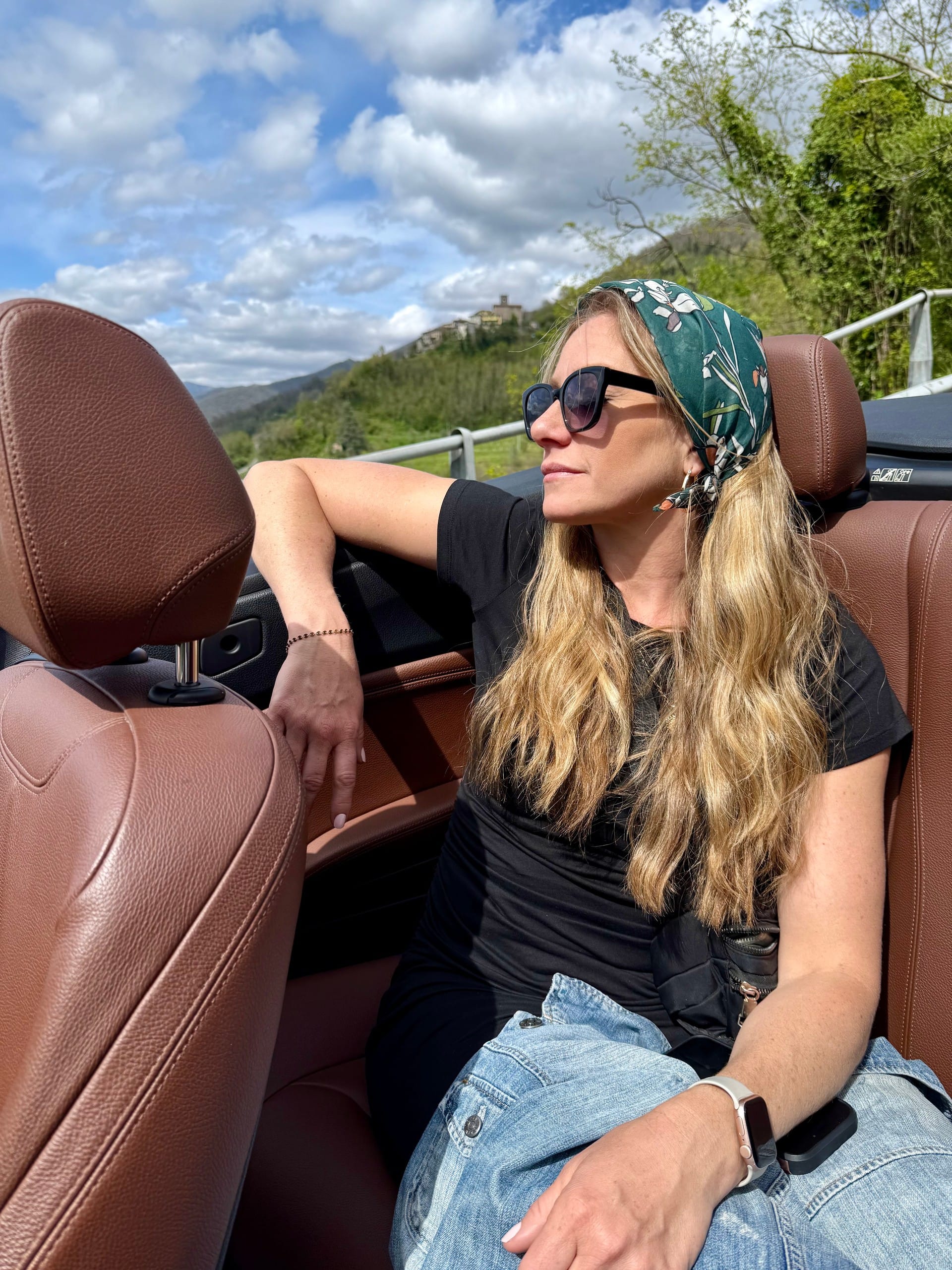
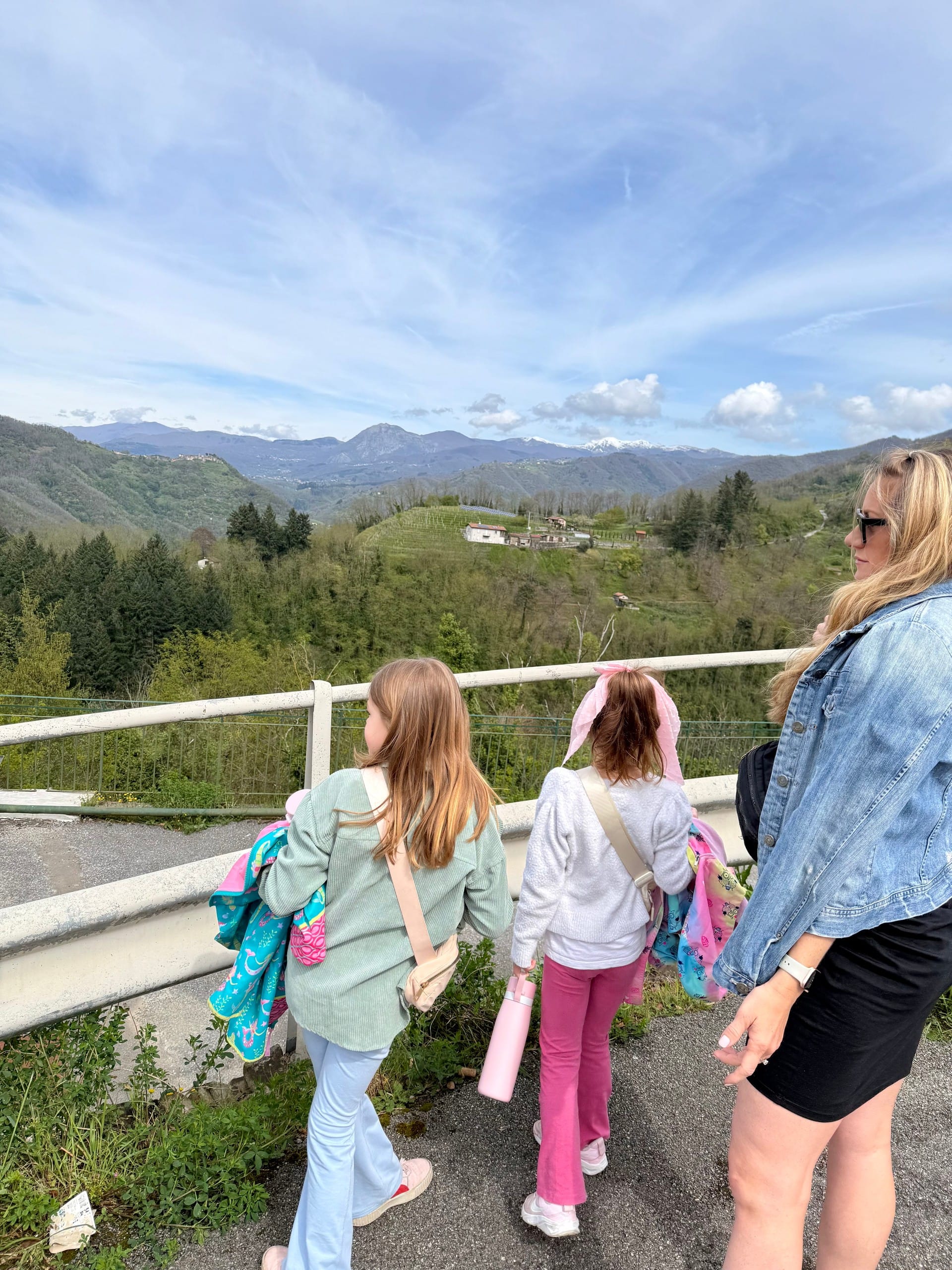
Top down through the switchbacks above Barga. The Serchio valley, snow still on the Apuane peaks.
At the top they screamed again. So we drove all the way back down and did it a second time, both of them half-convinced the hill was steep enough to tip us over backward.
Get "The Remember When Guide" — free. A short guide to planning your own family's adventure abroad, built from ten months of doing it ourselves.